Team NoahTCV takes first place as reconstruction quality reaches SOTA.
The ICCV 2025-MIPI “Deblurring for HVS/Hybrid-EVS Camera” challenge, co-organized by AlpsenTek, Pentas and Nanyang Technological University, has concluded. Launched in June, it drew 130 registered teams from industry and academia, with eight submitting complete results, code and technical documentation. Findings were reported at ICCV 2025 in October and published in the accompanying paper.
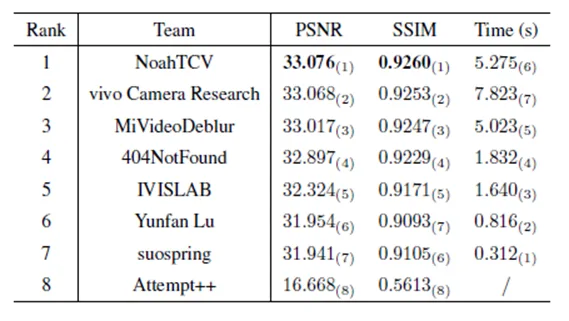
NoahTCV won the challenge, followed by vivo Camera Research and MiVideoDeblur. All three posted strong PSNR and SSIM scores, demonstrating excellent reconstruction quality; 404NotFound, IVISLAB, individual entrant Yunfan Lu and suospring also performed well.
On methodology, every team fused APS and EVS modalities in its network design. Roughly two-thirds adopted Transformer architectures or variants, while the rest used conventional CNNs — underscoring the coexistence of the two approaches. Some teams also introduced vision-language model (VLM) multimodal fusion, offering a new angle on handling heterogeneous HVS information.
The challenge confirmed a trade-off: better algorithm performance tends to come with longer inference times. Future MIPI challenges will therefore weigh inference efficiency (latency, model size) alongside image quality (PSNR/SSIM) to advance on-device hybrid-EVS deblurring and image enhancement.
“Breakthroughs in hybrid vision depend on deep coupling of algorithms, hardware and scenarios,” the organizers said, expressing hope that the competition will energize the global developer community and expand the frontiers of computer vision.