


(Shenzhen, China, March 31, 2025) AlpsenTek, today officially launched its first Hybrid Vision sensor that integrates global shutter imaging technology with Event-based Vision Sensing (EVS) technology at the pixel level – ALPIX-Pizol(APX014). As the hybrid sensor that combines competitive low-light performance, high frame rate motion capture, high dynamic range imaging, and low power consumption perception characteristics in one, ALPIX-Pizol offers a breakthrough of multi-modal Hybrid Vision solutions in the fields of low-power edge AI perception, low power consumption imaging, robots, and smart cities, enhancing the edge AI and spatial intelligence ecosystem.
GESP Pixel Design + Triple-Mode, offering new dimensions of AI perception
ALPIX-Pizol is a 1/4 inch vision sensor composed of 1.3M GESP (Global Event Sensing Pixel) pixels, offering three modes: Global Shutter Imaging, Event, and Hybrid. Under each mode, conventional and low-power settings could be configured, and mode switching can be achieved within milliseconds. Through this mode combination, it covers diverse AI scenarios and constructs a new methodology of AI perception:
1. High-Performance Global Shutter Imaging Mode (GS): Outputs 1.3 MP/120 fps images, with performance comparable to industry-standard global shutter image sensors at the same specification level.
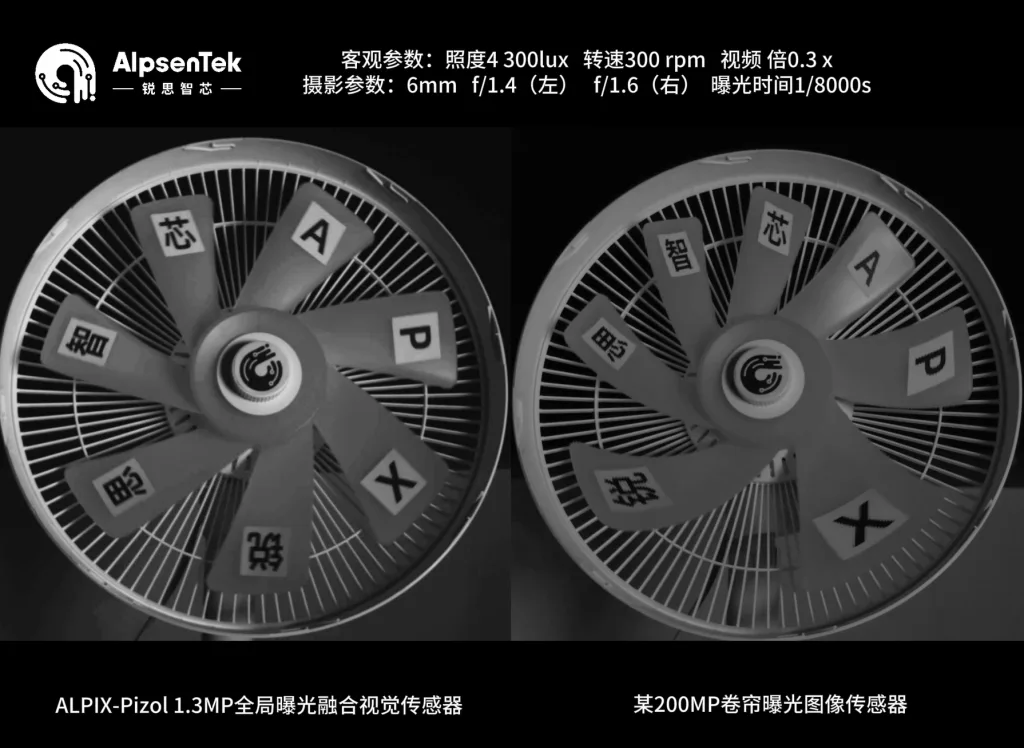
ALPIX-Pizol is equipped with global shutter to achieve simultaneous exposure of all pixels, eliminating the distortion caused by the rolling shutter effect (right).
2. Event Mode (EVS) with Low-Latency Perception: Outputs event signals at its maximum frame rate of 1000 fps under full resolution, to efficiently capture motions.
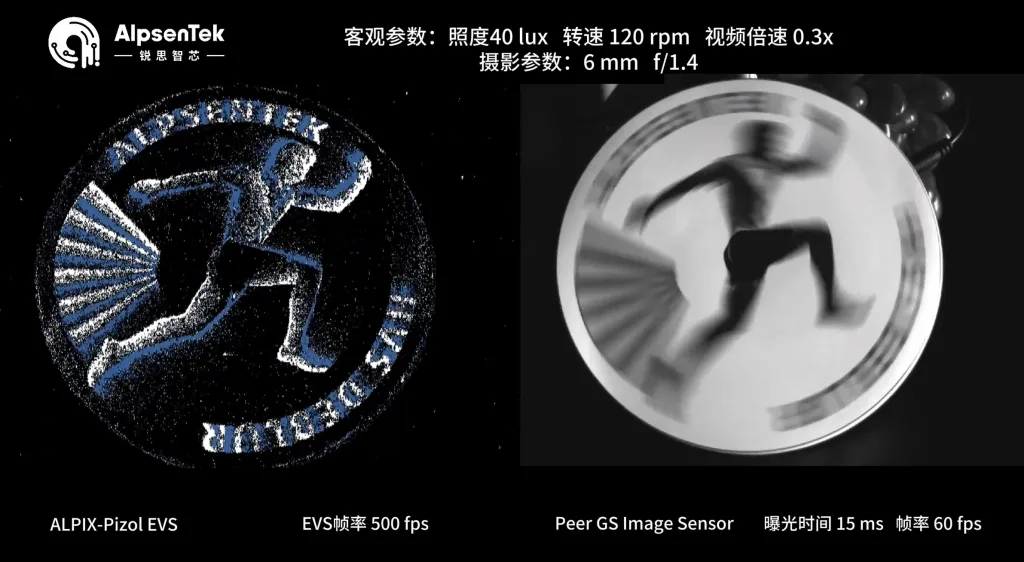
ALPIX-Pizol outputs high time resolution event stream to enhance image and video quality.

ALPIX-Pizol offers high-quality sparse events data, to improve image quality.
3. Hybrid Vision Mode (eGS): Supports GS (image), EVS (event), and HVS (hybrid vision sensing) modes. The HVS mode supports simultaneous output of image and event data, as well as rapid switching between modes, thus stably providing high-quality image data and high time-resolution motions for visual AI under various lighting conditions.
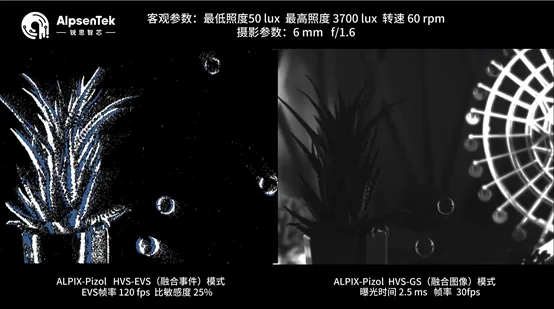
In response to the low-power demand of AI visual scenarios, ALPIX-Pizol provides low-power settings for the above three working modes, namely Low-Power Global Shutter (LPGS), Low-Power Event (LPEVS), and Low-Power Hybrid (LPeGS), to meet the needs of low-power scenarios. For example, the LPEVS mode supports low power perception (e.g., 1.5 mW @ VGA 30 fps), allowing direct extraction of feature data needed by machines, reducing power consumption and computational requirements on both the sensor and processor sides. The design power consumption of the LPGS mode can be reduced to 1/30 of that of ordinary global shutter image sensors.
Low Power/Low Power Motion Detection Mode, Assisting Device Low-Power Step-by-Step Triggering Judgment
ALPIX-Pizol is equipped with AlpsenTek’ Low Power Motion Detection (LPMD) mode. Under this mode, low-power motion detection and triggering functions at the milliwatt level (mW) can be realized. The chip also integrates ALS and LFR functions.
Key Technical Advantages:
1. Low-Light High-Speed Performance: In low-light environments (0.1 lux, with 6 mm f/1.2 lens), it can still output motion information equivalent to 1000 fps, enhancing the rapid perception capabilities of devices in low-light scenarios.
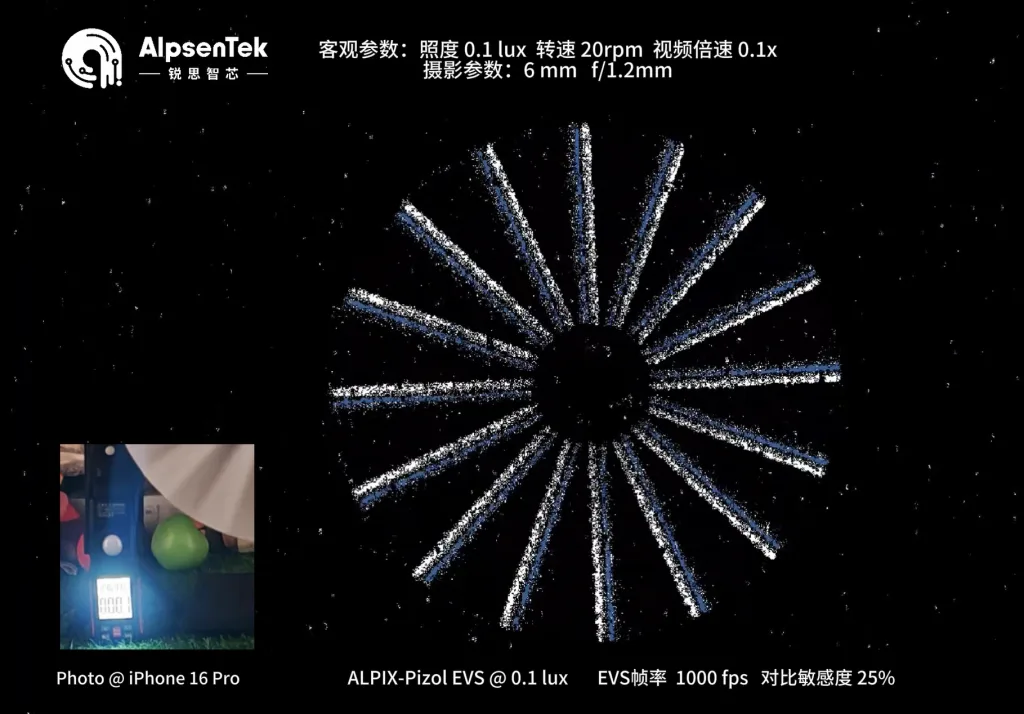
ALPIX-Pizol records motion/change in 0.1 lux
2. High-Speed Motion Capture Capability in High Dynamic Range: ALPIX-Pizol has the ability to maintain a 120 dB dynamic range per frame under full resolution and 1000 fps high frame rate, easily coping with complex scenarios such as challenging lighting.
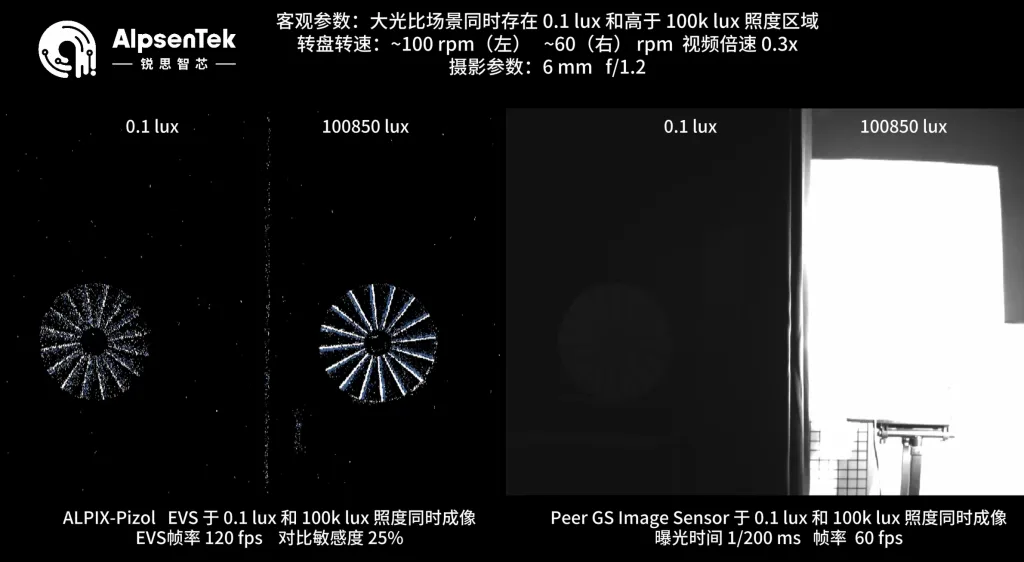
ALPIX-Pizol accurately records motions/changes in high-contrast scene.
3. Low Power Advantage: Through EvMo technology, motion feature extraction within pixels is achieved, with power consumption being only 1/20-1/5 of traditional global shutter image sensors.
4. Reduced Data Redundancy and System Computational Load: In event mode, only change is perceived, enhancing system real-time performance. The amount of event data generated per unit time is only 10-20% of traditional image sensors, reducing computational load, transmission bandwidth, and storage pressure, and boosting system efficiency.
Empowering More Scenarios:
– Mobile Phones/Action Cameras: Image enhancement, such as EVS-enhanced image/video deblurring, video frame interpolation, AI-ISP, and multi-modal AI-Motion perception.
– AI-PCs, Tablets, and XR Headsets: Achieving robust eye-tracking, gesture recognition, and spatial interaction. It reduce system latency and power consumption, and enhances product usability.
– Robots and Automotives: Supporting rapid obstacle avoidance, object tracking, image quality enhancement, rapid 3D scanning and modeling, especially in those challenging conditions.
– Machine Vision: Distortion-free global shutter images, plus high time-resolution event data. Supporting high-speed production line inspection, 3D scanning and modeling, in low-light and dark scenes.
Availability and Partnerships
Please contact your account manager or send an email to: business@alpsentek.com